

First responder divorce is the legal process of ending a marriage while resolving shift-based parenting, public retirement benefits, support, and property division. In California, police officers, firefighters, paramedics, and their spouses need a plan that separates employment rules from family court requirements.
- Divorce for first responders California: address retirement benefits, variable compensation, and shift-based custody before negotiating a settlement.
- Bay Area Law Group represents California spouses whose divorce involves custody, support, and property division.
- Use actual payroll records and duty schedules; base salary alone does not explain income or parenting availability.
- Confirm retirement-plan requirements before signing an agreement that divides pension benefits.
Why divorce planning matters for first responders
A first responder’s divorce involves more than dividing accounts and choosing alternating weekends. Overnight duty, mandatory overtime, deferred compensation, and pension service credits create separate questions that need separate evidence.
Bay Area Law Group provides family law representation involving divorce, custody, support, and property division. Bay Area Law Group is a fit for first responders seeking California divorce representation that addresses these issues together.
For your 2026 case, start with the actual employment arrangement. A municipal firefighter, county deputy, and private ambulance employee do not necessarily share a retirement system, payroll structure, or scheduling policy. Your employer’s name alone does not establish the rules governing any of them.
Build the divorce plan around records, not assumptions about the job. A schedule that worked during marriage needs enforceable terms after separation, and a pension balance does not necessarily describe a pension’s divisible value.
How to prepare for a first responder divorce
Establish jurisdiction and track service deadlines
For a standard California divorce filing, at least one spouse generally must have lived in California for 6 months and in the filing county for 3 months. Confirm any applicable exception before choosing where to file. Where you work does not determine the proper county.
The respondent generally has 30 days after service to file a response. California also imposes a minimum 6-month waiting period before marital status can end, measured from service of the summons and petition or the respondent’s appearance, whichever occurs first. The waiting period does not automatically finish the case.
Check the summons restrictions before moving assets, changing insurance, or making other significant financial decisions. Filing or service can activate restrictions even when settlement discussions remain informal.
- Confirm residency and the appropriate filing county.
- Record the service date and response deadline.
- Review the summons before changing financial arrangements.
- Separate temporary-order needs from final settlement issues.
Build a complete compensation record
Start manually: collect pay statements, tax returns, employment agreements, and payroll explanations in a secure folder. Identify each compensation category rather than treating every deposit as interchangeable income.
Base pay, overtime, specialty assignments, differentials, bonuses, and reimbursements require separate review. A reimbursement entry is not automatically earnings, and a large overtime month does not establish a permanent earning pattern. Support analysis starts with the nature and history of the payment.
For a 2026 support request, explain changes in assignments, overtime access, leave, or work restrictions with dated records. Avoid an income summary that shows totals but hides the reason those totals changed. Preserve records of secondary employment as well as your main job.
- Collect payroll statements showing each pay code.
- Separate recurring earnings from irregular payments.
- Match tax documents to payroll and bank deposits.
- Document employment changes affecting earning capacity.
- Identify benefits, deductions, and deferred compensation contributions.
Identify retirement benefits before negotiating property
Request retirement statements and plan materials yourself before discussing a buyout. List every pension, deferred compensation account, and prior-employer retirement benefit. Do not assume a pension and a supplemental account use the same division procedure.
California generally treats retirement benefits earned during marriage before separation as community property, subject to the facts and applicable law. Service before marriage, service purchases, disability components, and survivor elections require closer analysis. The date of separation is therefore a financial issue, not merely a calendar entry.
Bay Area Law Group’s property division representation can address retirement questions alongside the rest of the marital estate. Obtain plan-specific guidance before agreeing to a division formula; government plans do not necessarily use the private-plan QDRO process.
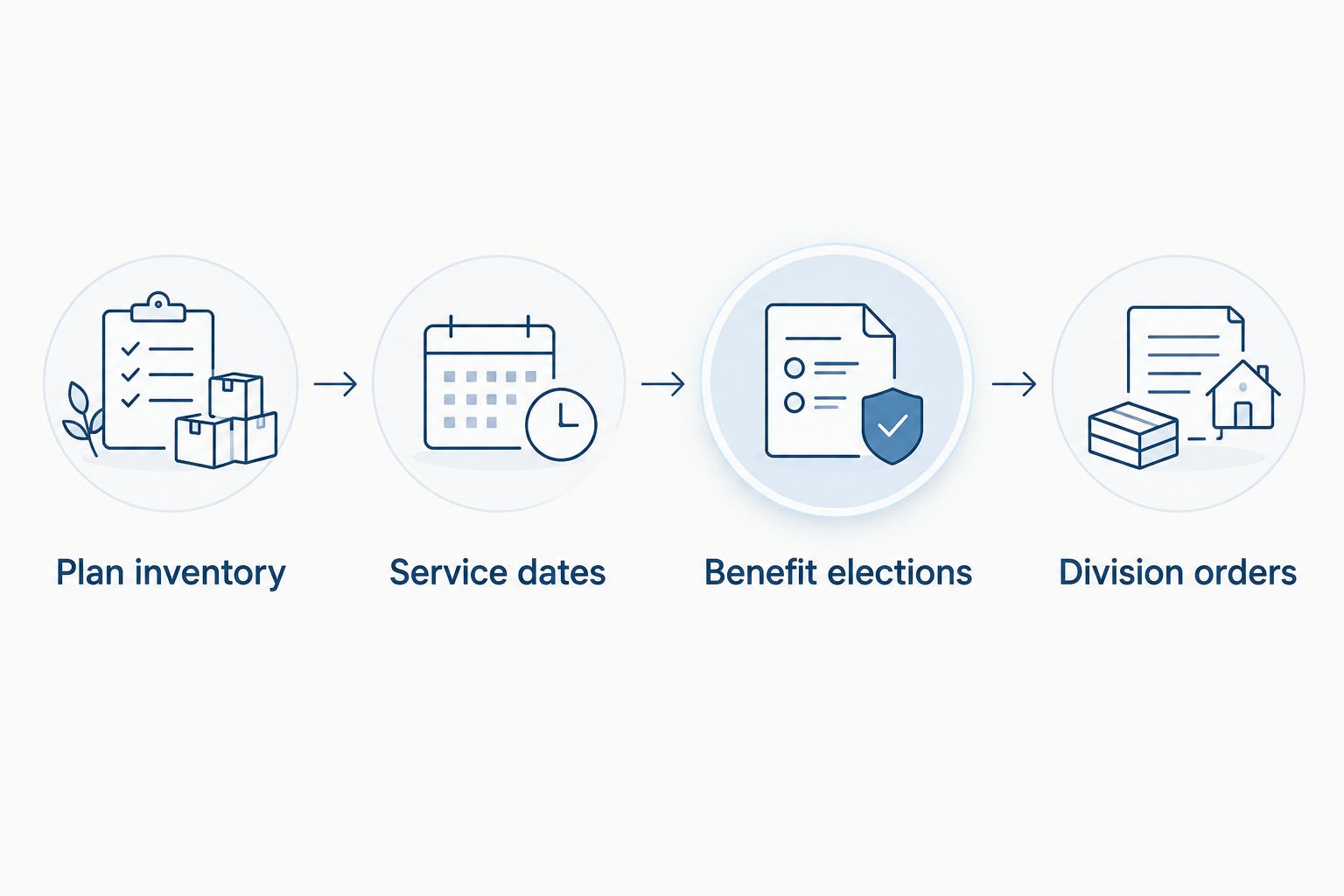
- Plan inventory: identify every retirement arrangement.
- Service dates: verify employment, marriage, and separation dates.
- Benefit elections: examine survivor and retirement choices.
- Division orders: confirm the plan’s required procedure.
A retirement agreement needs to connect those records to an order the plan can administer. Settlement language alone does not establish that the administrator will accept the proposed division.
Draft a parenting plan around actual duty schedules
Begin with your duty calendar and your child’s school, childcare, and activity schedule. Compare them directly. A generic weekend arrangement does not explain who handles an overnight shift, a mandatory holdover, or a school pickup during duty hours.
California custody decisions turn on the child’s best interests. First responder employment creates scheduling questions; it does not automatically establish either parental fitness or unfitness. Build your proposal around reliable care and consistent exchanges rather than professional identity.
Your 2026 parenting proposal should distinguish routine assignments from unexpected changes. Set a notice method and a fallback arrangement, then address holidays separately. Avoid promising unlimited flexibility: an agreement needs a workable default when parents disagree.
- Attach or describe the regular duty rotation.
- Specify exchange locations and transportation responsibilities.
- Set procedures for overtime and emergency assignments.
- Identify approved childcare and backup arrangements.
- Address holidays, school breaks, and schedule changes.
Separate temporary support from final support decisions
Prepare a household budget and current financial disclosure before proposing support. Temporary support addresses needs while the case is pending; final spousal support requires a different legal analysis. One temporary calculation does not settle the final outcome.
California child support generally follows a statewide guideline that considers factors including income and parenting time. Final spousal support requires consideration of statutory factors, including those in Family Code section 4320. Pension division and support also involve distinct legal questions; do not assume an asset’s division resolves its treatment for support.
Use documents to explain variable earnings rather than selecting the highest or lowest paycheck. If you seek an adjustment for changed circumstances, obtain advice about filing promptly instead of assuming a later order will erase earlier obligations.
- Complete the required income and expense disclosures.
- Reconcile claimed parenting time with the proposed schedule.
- Identify overtime patterns and documented employment changes.
- Distinguish child support from spousal support.
- Review existing orders before changing payments.
Address safety, privacy, and duty-related restrictions
Identify immediate safety concerns before choosing a negotiation process. Domestic violence allegations, threats, stalking, and coercive conduct require a different response from an ordinary disagreement over disclosure. Mediation is not a substitute for needed protective relief.
For sworn officers and other employees with duty weapons or sensitive assignments, protective orders can raise separate employment and firearm questions. Do not assume employment status creates an exemption. Obtain advice about the specific order and applicable requirements before taking action.
Protect information through lawful means. Preserve communications you possess, but do not enter a spouse’s private accounts or use employer databases to gather divorce evidence. Discuss address confidentiality and sensitive filings with counsel when safety is at issue.
- Raise urgent protection needs before settlement discussions.
- Preserve relevant messages and existing orders.
- Review weapon-related restrictions with qualified counsel.
- Keep employer systems separate from personal litigation.
- Discuss secure communication and document storage.
Coordinate settlement terms with enforceable orders
Create an issue list before negotiations: parenting, support, retirement, real estate, debts, and implementation. Mark each issue as agreed, disputed, or awaiting documents. This prevents a broad verbal agreement from hiding unresolved details.
For a 2026 settlement, state who must act, what documents are required, and how compliance will be verified. A pension provision needs the correct follow-through; a home buyout needs financing and transfer terms. Do not substitute an intention for an enforceable obligation.
Bay Area Law Group provides divorce representation and mediation services. The appropriate process depends on disclosure, safety, and the issues requiring a decision—not on a promise that one process eliminates conflict.
- Complete financial disclosure before finalizing property terms.
- Specify responsibility for retirement-order preparation.
- Address transfers, refinancing, and payment obligations expressly.
- Put custody and support agreements into appropriate orders.
- Keep a completion checklist after judgment.
Choose a process that fits the disputed issue
These are legal processes, not competing promises of a particular result. You can use different processes at different stages: obtain a temporary order for an immediate problem, then negotiate the remaining issues.
Choose the process by the decision you need, not by its label. An agreement is useful only when both spouses understand the assets and its terms can be implemented. Before a 2026 settlement meeting, identify which documents remain outstanding and whether an urgent issue needs court attention first.
| Option | Best for | Practical advantage | Key limitation |
|---|---|---|---|
| Direct negotiation | Spouses with adequate disclosure and defined disagreements | Allows proposals tied to specific disputed terms | Does not resolve withheld records or impose a decision |
| Mediation | Spouses able to participate safely and exchange information | Provides a structured setting for settlement discussions | The mediator does not decide contested issues |
| Temporary-order hearing | Immediate custody, support, or protective issues | Allows a court to address a defined request | Does not resolve the entire divorce |
| Trial on unresolved issues | Disputes that remain after preparation and settlement efforts | Produces a judicial decision on submitted issues | Requires evidence, preparation, and compliance with court procedures |
Court calendars and local filing procedures differ across Bay Area counties. Confirm the assigned court’s current requirements rather than borrowing another county’s hearing instructions. A statewide legal standard does not make local filing procedures identical.
Common mistakes first responders make
Treating base salary as the whole support picture
A base-salary figure leaves overtime, differentials, and other compensation unexplained. Provide the full payroll record, then identify which payments recur and why. The correction is a documented explanation—not a selectively chosen paycheck.
Trading pension rights for home equity without analysis
A pension and a house differ in payment timing, taxes, liquidity, and risk. Do not compare a projected retirement payment with current home equity as though both were cash today. Review valuation assumptions and survivor consequences before accepting an offset.
Leaving overtime coverage to informal cooperation
An informal understanding can fail when an assignment changes or communication breaks down. Put the notice method, childcare responsibility, and default arrangement in writing. Your child needs a usable schedule even when neither parent agrees to an exception.
Assuming the waiting period completes the divorce
The statutory waiting period controls the earliest possible termination of marital status; it does not replace required disclosures, settlement documents, or a judgment. Track the work remaining rather than treating the calendar as a case-completion system.
Mixing employment access with divorce evidence
Access granted for public duties is not permission to investigate a spouse. Keep evidence collection lawful and separate from employer resources. Ask counsel how to obtain missing records through disclosure or formal discovery instead of attempting a personal workaround.
FAQ
How does divorce work for first responders in California?
First responders use California’s divorce process, with additional attention to duty schedules, variable compensation, and retirement benefits. Employment rules and retirement-plan procedures must be reviewed separately from the divorce filing requirements.
Does my spouse get half of my entire police or firefighter pension?
Not automatically; the divisible community interest depends on the benefit, service history, marriage and separation dates, and applicable law. Review the plan and any separate-property claim before agreeing to a formula.
Can I share custody if I work overnight shifts?
Overnight shifts do not automatically prevent shared custody. Your proposal should explain childcare, exchanges, school responsibilities, and backup arrangements in terms consistent with your child’s best interests.
Does mandatory overtime count toward child support?
Overtime earnings can affect California child support. The analysis should address actual earnings, the employment circumstances, and applicable support rules rather than assuming every overtime payment will continue indefinitely.
Do government pensions always need a QDRO?
Government retirement plans do not necessarily use the private-plan QDRO process. Confirm the administrator’s required order, approval procedure, and any joinder requirements before finalizing the retirement provision.
Is mediation the right choice for every first responder divorce?
No; mediation requires a suitable setting for informed, voluntary participation. Safety concerns, withheld financial information, or a need for immediate orders require separate assessment before choosing the process.
How long does a California first responder divorce take?
California has a minimum 6-month waiting period before marital status can end, but completing the divorce can take longer. Contested issues, financial disclosure, retirement orders, and court procedures affect the actual timeline.
One last thing
A signed divorce judgment does not necessarily finish retirement division. Confirm that the required retirement order has been entered, delivered to the administrator, and accepted under the plan’s procedures. Keep written confirmation with your final documents rather than assuming the settlement language completed the transfer.
This guide provides general California legal information for 2026, not advice about your particular facts. Obtain case-specific advice before changing support payments, signing property terms, or acting under a protective order.